Agent control room · archived case study (2026)
AI agents that work like teammates, not tabs.
Chat with an orchestrator and an army of specialists — research, planning, design, dev, test, security, docs. Say the word, and it comes back with a PR, a demo video, a live link, and a plain-English list of anything that needs your call.
an archived 2026 proof of concept · not an active product
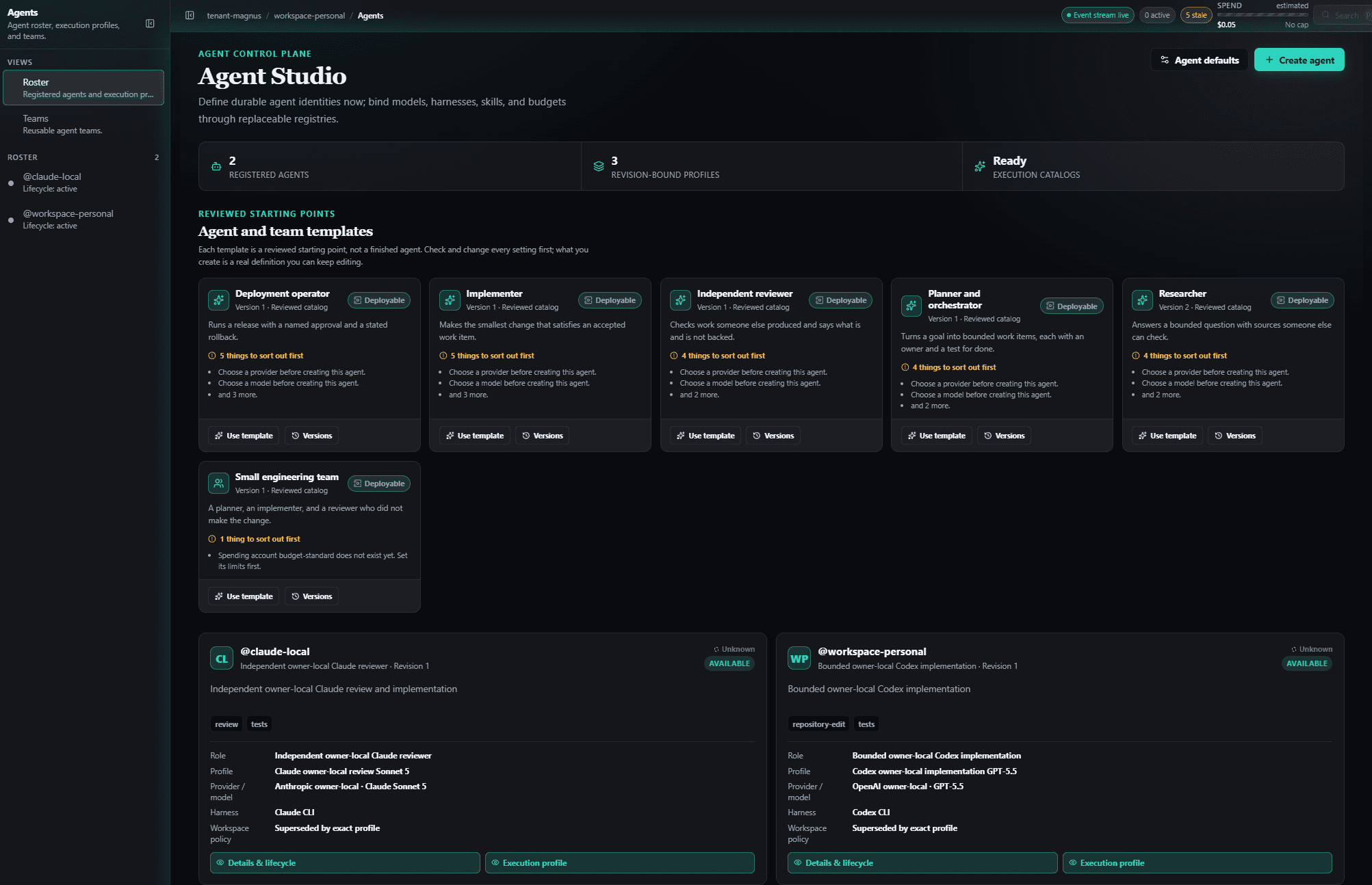
@orchestrator@research@planning@design@dev@test@security@docs
How it works
Write a prompt. Get notified when the work is done.
01
You @mention the orchestrator
“@orchestrator turn yesterday’s conversation into a feature.” That’s the whole job description.
02
It fans out to specialists
The right agents pick up the work — @research pulls decisions, @dev writes code, @security checks the blast radius.
03
You get proof, not promises
A PR on its own branch, a demo video, a live link in your environment, the full diff — and a plain-English list of anything that needs a human call.
donerun/7f3a delivered:full diff · 14 filesdemo 2:31live preview1 human call: retention window
Under the hood
Enterprise controls. Fresh out of the box.
Any model, your choice
Local, OpenRouter, or your existing Claude / ChatGPT subscription or API key. Nothing is locked in.
Memory that actually forgets
Decisions persist; superseded facts get scored on recency, source, and trustworthiness — then tombstoned instead of piling up.
A real audit trail
Every decision, human or agent, traces back to its source. Claims need evidence. Conflicts get surfaced, not buried.
Spend control to the token
Budgets per project, user, model, or time window — with a live dashboard that drills into individual conversations.
Mission control
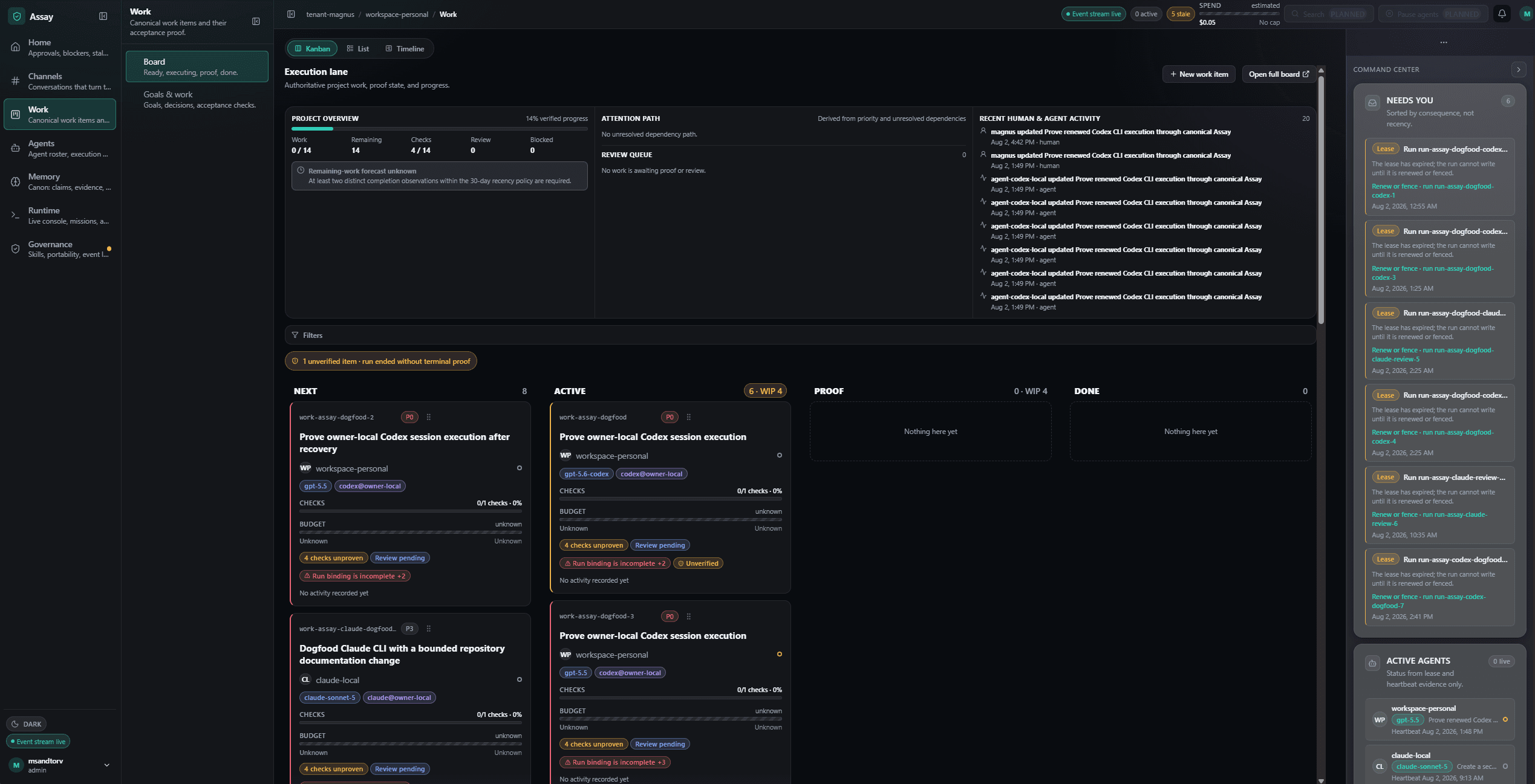
A live runtime console, session trees for parent/child runs, intent approvals, run status, and proof of what got produced.
Cross-model contracts
Define handoff rules so Codex and Claude work in tandem under terms you set — and review each other's work.
Bring your own tracker
Linear, Shortcut, Azure DevOps, Jira, or the built-in board. Every work item carries agent, model, effort, and priority.
API / CLI / MCP
For people who'd rather prompt it than watch a dashboard all day — or just check progress from the beach.
Spend$86.40 of $120 · July
Live budget drill-down, per conversation.
The part that changed how I work
Turns out AI is lazy. So assay checks its own work.
Anything risky or non-trivial runs through a self-critique loop: five specialist agents have to hit 97/100 before a second model gives a second opinion — and it sends work back for revisions about 6 out of 10 times. Ten to twenty agents doing this in parallel burns tokens, but a lot less than the hours you'd spend finding the bug yourself.
And they do it all while you sleep.
And they do it all while you sleep.